
What Actually Happens Between the Approval & Delivery of Contract Furniture?
Key Takeaways:
- The stretch between design approval and final delivery involves far more coordination than most buyers realize.
- Shop drawings, prototyping, and sampling all help confirm that a piece is production-ready before full manufacturing begins.
- Quality control checkpoints throughout production protect the final product and reduce costly surprises down the line.
- Freight, warehousing, and phased deliveries all play a major role in getting furniture on site at the right time.
- A coordinated process, managed by an experienced partner, keeps every stage moving in the right order.
For a lot of buyers, signing off on a furniture design feels like crossing the finish line. The selections are made, the finishes are chosen, the layout is set, and now it’s just a matter of waiting for everything to show up. But that moment of approval is really just the beginning…
Between a signed-off design and a fully-installed space, there’s a lengthy, yet carefully coordinated stretch that many clients never see. It’s where good commercial furniture projects are quietly protected, and where poorly managed ones tend to unravel.
So, what actually happens in that “invisible” middle stage? Let’s walk through it, step by step.
Understanding the Contract Furniture Manufacturing Process
The contract furniture manufacturing process is best understood as a sequence, not a single event. Each stage builds on the one before it, and skipping or rushing any step tends to create ripple effects later on.
At a high level, the journey from approval to delivery moves through design finalization, production, quality control, freight and logistics, warehousing, and installation. Every one of those stages involves its own set of decisions, timelines, and coordination, which is exactly why an experienced partner matters so much once the design is locked in.
Understanding how these pieces fit together also helps set realistic expectations. When clients know what’s happening behind the scenes, timelines feel less like a mystery and more like a smart plan.
From Approved Design to Production-Ready Specs
Before anything gets built, an approved design has to become a set of precise, buildable instructions. This is one of the most important parts of the entire furniture manufacturing process, because it’s where the design vision gets translated into exact product specifications.
What role do shop drawings and final approvals play?
Shop drawings are the detailed, production-ready drawings that translate an approved design into exact dimensions, materials, joinery, hardware, finish details, and more. It’s essentially the blueprint our factory will build from — and on custom furniture projects, it’s a highly collaborative step.
The design direction comes from the client and their designer or design firm, and the manufacturing partner works to confirm that every detail is captured accurately before production begins. Depending on the project, that collaboration can look a little different with each partner, but the goal is always the same: make sure what’s about to be built matches the approved vision.
How important is prototyping and sampling before full production?
For custom pieces especially, prototyping and sampling add another layer of confidence. A prototype lets everyone see and experience a piece of furniture before committing to a full production run, while material and finish samples confirm that colors, textures, and quality meet expectations.
It’s a step that’s easy to want to skip in the name of speed, but it’s often the difference between catching an issue on one sample versus discovering it across an entire order. Getting it right here protects both the budget and the timeline.
Inside the Manufacturing & Quality Control Stages
Once everything is approved and confirmed, production begins — and this is likely the stage most people picture when they think about furniture manufacturing.
How is contract furniture actually built at scale?
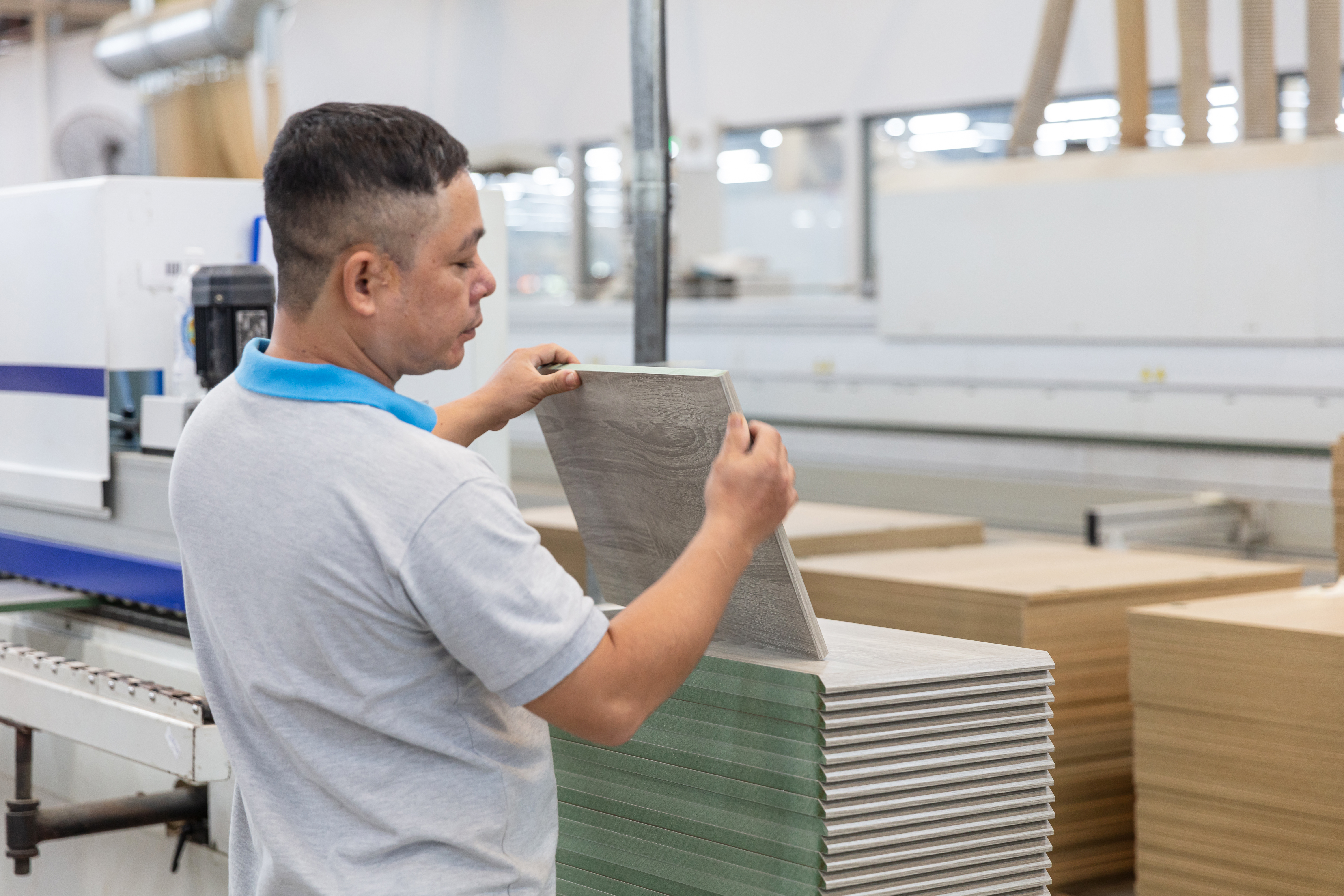
Manufacturing commercial furniture at scale is a different discipline than building a single piece. Frames are cut and assembled, surfaces are finished, upholstery is applied, and hardware is installed, all according to the specifications locked in during the shop drawing stage.
Doing this consistently across hundreds or thousands of pieces requires reliable systems and a close relationship with the factory floor. Commercial-grade construction methods, like reinforced joinery and durable finishes, are built in at this stage precisely because these pieces are engineered to hold up during years of heavy use in high-traffic settings, such as hospitality, higher education, commercial workspaces, and beyond.
This is also where a reliable, integrated supply chain makes a significant difference. At Smarter Furnishings, our manufacturing runs through a dedicated factory in Vietnam with our own team on site, including a Manufacturing & Sourcing Consultant who lives there to help keep every project moving efficiently. For our partners, this direct connection means fewer layers and potential bottlenecks between the design that was approved and the products that get built.
How does quality control help protect the final product?
Quality control isn’t a single inspection at the end. It’s a series of checkpoints woven into every project throughout production, confirming that materials, construction, and finishes meet the agreed-upon standards at every step.
Our quality control process typically looks like this:
- Inspect incoming materials before production begins
- Check construction and finishes at key points during the build
- Review finished pieces against the approved specifications
- Confirm consistency across the full order before anything ships
And because part of our team is on site at the factory year-round, that oversight happens in person and in real time, keeping quality reliable across multiple projects and years.
Freight, Shipping, & Logistics Coordination
With production complete and quality confirmed, furniture has to make its way from the factory to your site. For many commercial projects, this involves overseas manufacturing, which adds coordination steps that can significantly influence timelines.
What affects contract furniture lead times?
Contract furniture lead times are shaped by a number of moving parts, and understanding them upfront helps set realistic expectations.
Common factors include:
- The level of customization and complexity in the pieces
- Global production schedules and factory capacity
- Overseas shipping timelines and freight availability
- Customs, port activity, and inland transportation
- The sequencing of deliveries around your project schedule
Because so many variables are in play, lead times are rarely one-size-fits-all. Clear communication early in the process is what turns these unknowns into a manageable plan.
How does overseas freight coordination keep projects on track?
Overseas freight is the step where we coordinate production schedules with shipping windows, manage customs and documentation, and plan inland transportation, all of which requires proactive attention long before furniture arrives.
This is another reason why having a team on the ground at a dedicated factory pays off. That presence gives us closer visibility into both production and freight, helping us anticipate and navigate the kinds of disruptions that can otherwise catch a project off guard.
Warehousing, Delivery, & Installation
Furniture arriving on site is not quite the same as furniture being ready for all the moments that unfold in a commercial space. This final stretch is where careful coordination turns an exciting shipment into an intentionally-designed finished environment.
The benefits of warehousing and phased deliveries
Rarely does a project need every piece to arrive on the same day. Warehousing solutions allow furniture to be received, stored, and staged until a space is actually ready, which protects products from damage and keeps job sites clear.
Phased deliveries take this a step further, coordinating shipments to arrive in the right sequence and at the right time. For projects working around tight schedules or shifting timelines, this kind of flexibility can often be the difference between a smooth rollout and a logistics headache.
How does installation bring it all together?
For projects that need it, furniture installation is where all the earlier stages finally come together in the space itself. Furniture is delivered, unpacked, assembled, and carefully placed according to the plan, transforming an empty room into a purposeful finished environment.
Not every project calls for full installation support, and some teams prefer to coordinate this stage themselves. But when it’s part of the scope, a coordinated installation, ideally supported by on-site project management, keeps this final stage organized and accountable. When the crew handling the install understands the project and communicates clearly, the last step feels less like a scramble and more like the natural conclusion of a well-run process.
Why a Coordinated Process Makes All the Difference
Looking at the full journey, one thing becomes clear: no single step stands alone. A delay in approvals affects production. A gap in quality control shows up at installation. A freight surprise throws off the whole delivery schedule. That’s why coordination and collaboration between designers, furniture manufacturers, clients, and other partners is key throughout the entire project.
A Smarter Path from Furniture Approval to Delivery
The stretch between approval and delivery doesn’t have to be an unknown part of the process. With the right partner managing each stage, what happens behind the scenes becomes a source of confidence rather than uncertainty. That’s exactly how we approach every project at Smarter Furnishings, with proactive communication and careful coordination at every step.
If you have a project on the horizon and want each stage handled with care, we’re here to help. Reach out to start the conversation with Smarter Furnishings.
For more insights like this, explore the Smarter Furnishings blog here.